
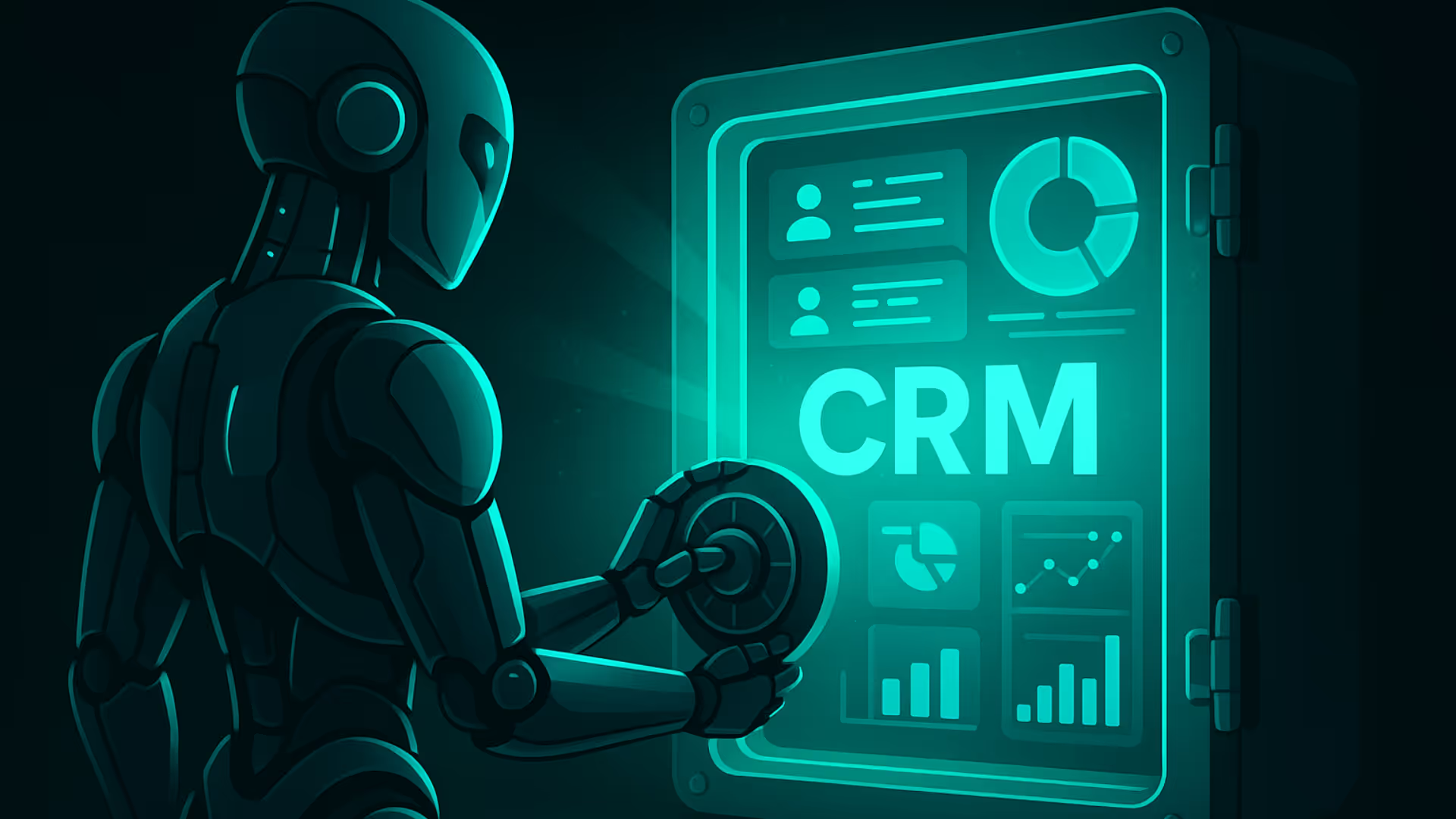


An AI CRM uses artificial intelligence to help sales teams predict outcomes, automate tasks, and close more deals by turning customer data into actionable insights.
They are transforming the way businesses manage customer relationships.
In this blog, you’ll get to read about key features, benefits, popular AI CRMs, steps to get started and more.
What is an AI CRM?
Key features of AI-powered CRM
Predictive lead scoring
AI analyses past conversion patterns and assigns scores to leads based on their likelihood to convert. This helps sales teams focus on high-potential leads first.
AI chatbots and virtual assistants
Built in AI bots engage website visitors, qualify leads, answer FAQs, and schedule meetings 24/7 reducing the workload on sales and support teams.
Sales forecasting
AI analyses historical sales data, pipeline trends, and market patterns to accurately predict future revenue and deal closures, helping teams plan better.
{{callout-3}}
Intelligent automation
Automates repetitive tasks like follow-up emails, data entry, reminders and task assignments, boosting productivity and eliminating manual errors.
Sentiment analysis
AI detects customer tone and emotions in sales emails and calls to understand satisfaction levels. This helps teams tailor responses and resolve issues proactively.
Personalisation engine
Delivers tailored content, product recommendations, and communication based on each customer’s behaviour and preferences, driving higher engagement and conversions.
AI powered analytics
Provides deeper insights with smart dashboards, trend analysis, and performance recommendations, enabling data-driven decision-making instead of guesswork.
How does an AI CRM work?
An AI CRM works by combining customer data with artificial intelligence to analyze customer interactions, identify patterns, generate insights, and automate sales and customer relationship tasks. Instead of simply storing information, an AI CRM can use that information to help teams decide what to do next.
The process typically works across five stages:
1. Collects customer data
An AI CRM gathers information from interactions such as emails, calls, website activity, forms and CRM records.
2. Analyzes customer behavior
AI identifies patterns in customer activity, engagement and historical outcomes.
3. Generates predictions and recommendations
The system can identify high-intent leads, forecast deals, flag risks or recommend next actions.
4. Automates repetitive tasks
AI can help with follow-ups, data entry, reminders, summaries and other repetitive activities.
5. Continuously learns from new data
As more customer and sales data becomes available, the system can refine its recommendations and predictions.
Benefits of AI CRM for sales teams
- Saves time through automation
- Boosts sales productivity and efficiency
- Supports data driven decision making
- Enhances customer experience with hyper personalization
- Improves marketing ROI
- Reduces churn using predictive alerts
AI CRM vs Traditional CRM
How to choose the right AI CRM?
Ease of implementation
Choose a CRM that’s simple to set up and user friendly. A complex system can slow adoption, so look for intuitive interfaces and strong onboarding support.
AI features relevant to your team
Not every business needs every AI tool. Focus on features that match your goals like predictive lead scoring for sales, sentiment analysis for support, or automation for marketing.
Integration capability
Ensure that the CRM integrates smoothly with your existing tools such as email, marketing automation platforms, or ERP systems. Seamless connectivity keeps your data consistent and workflows efficient.
Pricing and scalability
Pick a CRM that fits your budget today but can scale as your business grows. Check for flexible plans, user-based pricing, and transparent upgrade options.
Data privacy and security
Since AI CRMs handle large amounts of customer data, strong data protection is crucial. Look for platforms that comply with GDPR or other data regulations and offer encryption and role-based access controls.
Steps to get started with AI powered CRM
Identify manual and repetitive tasks
Begin by mapping out tasks that consume time like data entry, lead follow-ups, or email reminders. These are ideal areas where AI can bring immediate efficiency.
Start with AI automation for one process
Don’t overhaul everything at once. Start small, say for example, automate one process(such as lead scoring) at a time and measure its impact before expanding to other areas.
Train your team
AI tools are only as effective as the people using them. Offer proper training so your sales, marketing, and support teams understand how to use AI features confidently and interpret the insights they generate.
Integrate with existing tech stack
Connect your AI CRM with other tools like email marketing software, customer support platforms or analytical dashboards. Integration ensures smooth data flow and eliminates silos.
Track performance metrics
Regularly monitors KPIs such as lead conversion rates, response times and customer satisfaction scores. Tracking results helps in refining AI strategies and measuring ROI effectively.
Challenges and considerations
Data Quality
AI systems are only as effective as the data they rely on: the classic principle of “garbage in, garbage out” applies here. For an AI-powered CRM to deliver accurate insights and recommendations, it needs access to clean, well-organized, and up-to-date customer data. Inconsistent or incomplete records can lead to flawed predictions, wasted marketing spend, and poor customer experiences. Businesses must therefore prioritize regular data audits, validation, and integration across all platforms.
Cost and ROI
Implementing AI CRM involves a significant initial investment ranging from software costs to integration and training. However, the focus shouldn’t just be on the cost but on the long-term value it creates. Businesses should establish clear KPIs to measure ROI, such as improved lead conversion rates, reduced churn, or time saved through automation. Over time, a well-optimized AI CRM can pay for itself by driving efficiency and smarter decision-making.
Change management
Adopting AI tools requires more than just technology; it calls for a shift in mindset and workflows. Teams may resist change or feel uncertain about relying on AI-driven insights. That’s why it’s crucial to invest in training, communicate the benefits clearly, and involve team members early in the implementation process. A smooth transition depends on building confidence and ensuring everyone understands how AI enhances (not replaces) their roles.
Indirect ROI of AI CRM
Predictive churn prevention strategies
When AI flags a high-risk customer, teams can act fast by re-engaging through personalized offers, proactive check-ins, or tailored support. These interventions help reduce churn and increase Customer Lifetime Value (CLV).
Inter departmental strategy
AI CRM connects sales, marketing, and support teams through shared, real-time insights, ensuring everyone works from the same customer data and strategy.
Reduced CAC and costs
Smarter target and automation lower Customer Acquisition Costs (CAC) and reduce operational overhead, delivering higher efficiency.
Which is the most popular AI CRM tool?
Superleap is an AI CRM designed to automate data capture, lead tracking, and workflows. Its built-in AI co-pilot offers real-time insights, call analysis, and sentiment tracking, helping teams focus more on selling than manual tasks. Best suited for growing businesses seeking automation and speed.
Conclusion
CRMs deliver value by automating tasks, providing predictive insights (like lead scoring), and enabling hyper-personalization. This results in smarter, data-driven decisions, significant efficiency gains, reduced churn, and lower customer acquisition costs.
Psychological barriers to trusting machine generated prediction
One of the most subtle, yet powerful, obstacles to adopting an AI CRM is the human psychological barrier to trusting machine-generated predictions. Sales and marketing professionals have long relied on gut feeling, personal relationships, and their own experience to forecast sales and qualify leads. When an AI model provides a different, data-driven prediction, the natural reaction can be skepticism or resistance.
Key elements of this barrier include:
- Lack of transparency
- Fear of replacement
- Over reliance and complacency
Overcoming these barriers requires clear communication, robust training that focuses on AI as an enhancer, not a replacement, and ensuring the CRM offers sufficient data visibility so teams can audit and understand the logic behind the predictions




%201%20(1).svg)
.svg)
.svg)
.svg)
.svg)