.svg)



Lead generation is an essential marketing strategy that converts anonymous web traffic into identifiable prospects, filling your sales pipeline with interested and qualified individuals.
In today’s competitive digital landscape, a planned strategy and flawless execution are critical for a high-performing lead generation campaign.
Here is a comprehensive guide to building a high-performing lead generation strategy for your business.
What are lead generation strategies?
To master this, you must first understand the entire lead generation process.
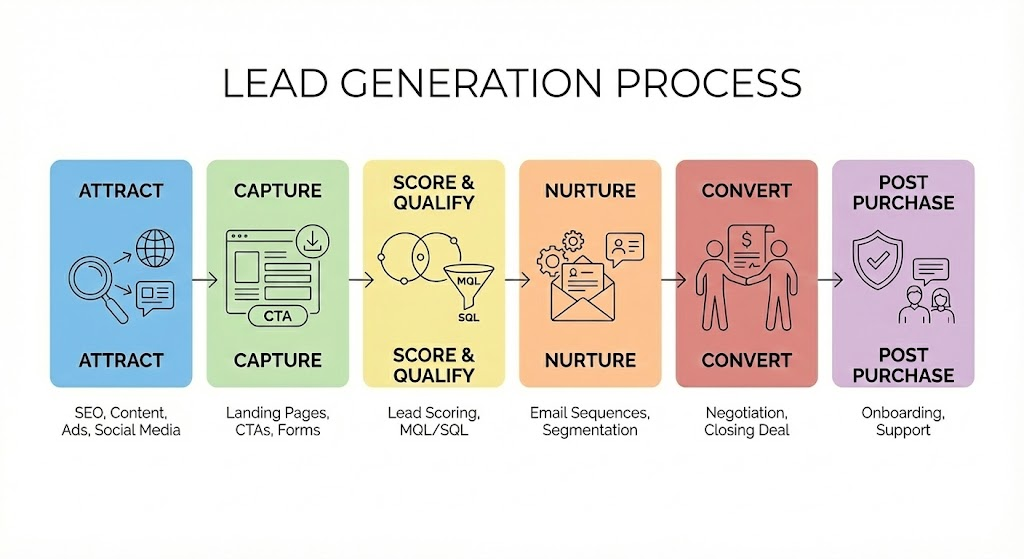
MQL (Marketing Qualified Lead): Has engaged with content; ready for marketing nurture.
SQL (Sales Qualified Lead): Has expressed intent (e.g., requested a demo); ready for sales team outreach.
This 6 step process is driven by two types of marketing activity: Inbound and outbound.
A. Inbound strategies
Inbound methods focus on attracting leads by providing value. In this case, the lead initiates contact which usually results in higher conversion rate and lower acquisition cost.
They include:
Content Marketing: Creating valuable, relevant content (blogs, e-books, videos, templates, webinars) that addresses your target audience’s pain points. Content here is often ‘gated’ requiring an email address for access (a key conversion point).
Search Engine Optimization (SEO): Optimizing your website and content to rank highly for relevant keywords. Strong SEO practices ensure that your business is discoverable when prospects are actively searching for solutions.
Social Selling: Using social platforms like LinkedIn to build relationships, provide insights, and engage directly with prospects, moving away from purely promotional posts.
B. Outbound Strategies
Outbound methods involve proactively reaching out to prospects.
Paid Advertising (PPC/SEM): Running targeted ads on search engines (Google Ads) and social media (LinkedIn, Facebook) to drive immediate, qualified traffic to a dedicated landing page.
Cold Outreach: Highly personalized cold email campaigns or direct mail targeted at specific Ideal Customer Profiles (ICPs) and decision-makers.
To implement these strategies effectively and yield maximum results, leveraging your digital channels is important.
Role of digital marketing in the lead generation process
The relationship between digital marketing and lead generation occurs in the ‘attract’ and ‘nurture’ stages. Here’s how:
How to run an effective lead generation campaign?
A lead generation campaign is a time-sensitive, focused effort to achieve a certain goal. To run a campaign effectively, focus on these five components:
Define ICP: You must know who your target audience is and target a specific persona (e.g., ‘HR Directors at mid-market tech companies in the EU’). This will serve as the deciding factor for everything from messaging to channel selection.
Offer irresistible lead magnets: Lead magnets are high-value items/service that you must offer in exchange for contact information. These could be detailed white papers, data reports, interactive tools like calculators, case studies and more.
Build dedicated landing pages: Ensure your landing page has a clear target. Always match the header to the ad/email that drove the visitor to the site, highlight the benefit of the lead magnet and feature a simple, mobile optimized form as well.
Choose strategic promotion channels: Where will your ICP find the offer? Promote the campaign across your selected channels (e.g., LinkedIn Ads targeting specific job titles, SEO-optimized blog posts pointing to the offer, and an email banner to existing subscribers).
Implement a nurture sequence: Lead conversion doesn’t mean the campaign is over. Set up an automated 3 to 5 email sequence that immediately delivers the asset, then follows up over the next two weeks with supporting resources, testimonials, and eventually a soft CTA to book a demo or consultation.
Lead generation Metrics
Once your campaign is running, analyzing the results is essential to optimizing performance. Track these core-metrics for the same.
CPL (Cost Per Lead)
Amount spent on acquiring one marketing lead
Formula: CPL = Total Campaign Cost ÷ Number of Leads Generated
Lead to customer conversion rate
Refers to the percentage of leads that eventually become paying customers.
Customer Acquisition Cost (CAC) and Lifetime Value (LTV)
Ensuring your lead generation efforts provide a healthy return on investment (LTV/CAC ratio).
To effectively track and analyze these rates in real-time requires a 360 degree CRM like Superleap.
Conclusion
Your lead generation strategies will pay off with unified marketing and sales goals and consistent efforts. To achieve this level of funnel efficiency, a CRM and other integrations are paramount.
Book a demo with Superleap, designed to automate the process by providing real-time analytics, automated lead scoring, and nurturing sequences necessary to convert more high-quality prospects faster.
Heading text
Nunc sed faucibus bibendum feugiat sed interdum. Ipsum egestas condimentum mi massa. In tincidunt pharetra consectetur sed duis facilisis metus. Etiam egestas in nec sed et. Quis lobortis at sit dictum eget nibh tortor commodo cursus.
Odio felis sagittis, morbi feugiat tortor vitae feugiat fusce aliquet. Nam elementum urna nisi aliquet erat dolor enim. Ornare id morbi eget ipsum. Aliquam senectus neque ut id eget consectetur dictum. Donec posuere pharetra odio consequat scelerisque et, nunc tortor.
Nulla adipiscing erat a erat. Condimentum lorem posuere gravida enim posuere cursus diam.