
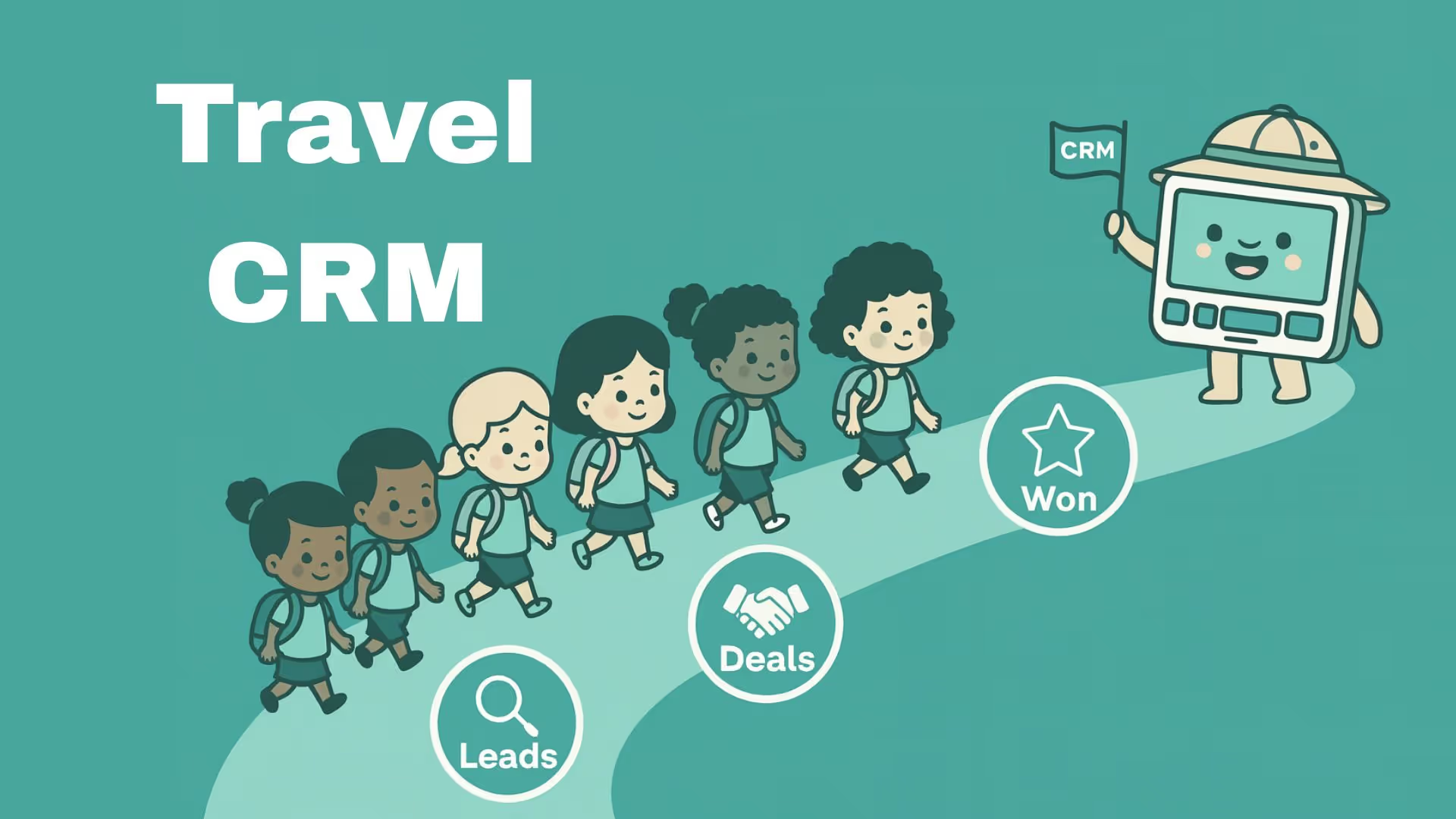


When managing client inquiries, bookings, vendor partnerships, and marketing campaigns, scattered data is the last thing you want. Implementing a CRM ensures all your critical information and activities are centralized on a single platform, preventing data loss.
According to growthmarketreports, the market size of the CRM travel agency is valued at $1.87 billion in 2024 and is estimated to touch $5.48 billion by 2033, growing at a CAGR of 13.2% in the period forecast.
For tour operators, implementing a travel agent crm translates to customer satisfaction and even higher sales. How? In this guide, you will learn how a travel crm works, their features and how to choose the best one for your agency.
What is a travel CRM?
Example workflow: Lead from Facebook → automated follow-up → trip proposal → payment reminder → post-trip review request.
Superleap AI CRM offers automated follow-ups, WhatsApp workflows, itinerary communication, and lead capture across channels (forms, ads, WhatsApp, and social channels) - all essential for travel agencies today.
How does a travel CRM software work?
A potential customer contacts the travel agency through various channels (website form, social media ad, email, phone call, walk-in, etc.)
The CRM adds a new profile for that customer with required details (contact details, source of inquiry, and initial travel interest)
The system scores and qualifies the customer based on buying intent and assigns them an appropriate agent.
The assigned agent then contacts the customer to better know their preferences and build a 360 degree customer view.
The system provides an itinerary builder tool which is used to pull information on pricing and availability from integrated Supplier/Vendor management modules (flights, hotels, tours) to tailor a personalized travel package.
The quote is sent to the client and their interest is monitored. Accordingly, the agents follow-up on a timely basis.
In case the client accepts the proposal and payment is made, the status changes from lead to a client profile and a confirmation email is sent along with necessary booking details.
Trip details (tickets, vouchers, insurance) are stored under the profile name in the travel agent CRM for easy access of both agent and client.
Upon return, a feedback/review is requested from the client.
The agent stays in touch with the client with the system triggering automated emails for special occasions or discount seasons encouraging customer loyalty/repeat business.
Key features to look for in a travel CRM
- Itinerary & booking management: Allows building custom travel packages which include flights, hotels, tours, and activities with seamless reservation management via a direct GDS connection (According to epsilon, 80% of the customers are more likely to make a purchase when offerings are personalized).
- Supplier & vendor management: Stores supplier contact and tracks all communication ensuring no information is missed between supplier and agent.
- Multi-channel communication: Facilitates interaction with clients via mail, phone, SMS, whatsapp or chat from the CRM to send timely updates.
- Mobile access: Mobile CRM allows on-the-go agents update status in real time especially in weak signal zones.
- Automation & AI workflows: Customizable workflow, automates routine follow-ups and trigger actions like sending email itinerary upon booking confirmation, personalized communication.
Superleap AI has automated workflows triggering actions upon status update. You can also set conditions to trigger automations based on user responses.
- Analytics & reporting: Dashboards provide unified insight into metrics like booking rates, client ROI, or sales pipeline progress. Ideal to inspect & improve sales strategies.
- Customization & scalability (check beforehand): Allows custom fields as per your requirement whether it is leisure travel, corporate travel, or special tours. As the agency grows, it allows for new additions to handle more data.
- Security & compliance: Protect traveler data and comply with travel regulations (like GDPR if you operate in Europe or handle such data).
Integrations that actually matter for travel: A travel CRM is only as useful as what it connects to. Look specifically for GDS integrations (Amadeus, Sabre, Galileo) for live flight and fare data, payment gateway support for deposits and installment plans, and WhatsApp Business API access since WhatsApp is now the primary booking-communication channel for agencies across South Asia, the Middle East, and much of Southeast Asia.
Why do tour operators need a travel agent CRM?
- To increase bookings and sales productivity.
- To connect with hotels, airlines, buses, and DMCs to check real-time availability.
- To send quotes, reminders, and invoices automatically.
- To manage operations, accounts, and sales via one dashboard.
With Superleap, you can respond faster by automating Whatsapp replies, and email sequences ensuring no lead is missed during peak travel seasons.
In practice: Peak season is where the gap between a CRM-run agency and a spreadsheet-run one shows up fastest. A mid-size agency fielding 200+ inbound inquiries a day during a holiday booking surge can't manually route, qualify, and follow up on each one within the response window that actually converts - most travel bookings go to whichever agency replies first with a workable quote. Automated lead scoring and instant WhatsApp acknowledgment aren't a nice-to-have here; they're the difference between capturing that surge and losing it to a competitor who replied in minutes instead of hours.
How to choose the right travel CRM for your agency?
Not every CRM suits every travel business. Here's a quick selection guide:
- If you handle large enquiry volumes: Choose a CRM with strong automation + WhatsApp workflows.
- If you sell customised trips: Ensure the CRM supports itinerary building or integrations.
- If you manage group or corporate travel: Look for approval workflows + multi-currency quotes.
- If your team works remotely: Ensure the CRM offers a powerful mobile app.
- If you want better conversions: Choose a CRM with AI-driven follow-up and reminders.
What to compare across travel CRM options
Pricing for travel CRMs generally scales with team size and automation depth - smaller agencies typically start on per-agent monthly plans, while larger operators with high enquiry volume often move to usage-based or custom pricing tied to lead volume and integration needs.
It's worth requesting a quote based on your actual monthly enquiry count rather than comparing sticker prices alone, since the difference between plans is usually about automation limits and integration access, not the base feature set.
Conclusion
Selecting the best CRM for travel agencies depends on your business size, niche, and growth plans. Start by listing your “must-have” features (for example, do you need itinerary automation or robust analytics?). Then compare providers, read user reviews and try demos.
Contact Superleap AI CRM to book a demo and make your investment today!



.avif)
%201%20(1).svg)
.svg)
.svg)
.svg)
.svg)