
.avif)


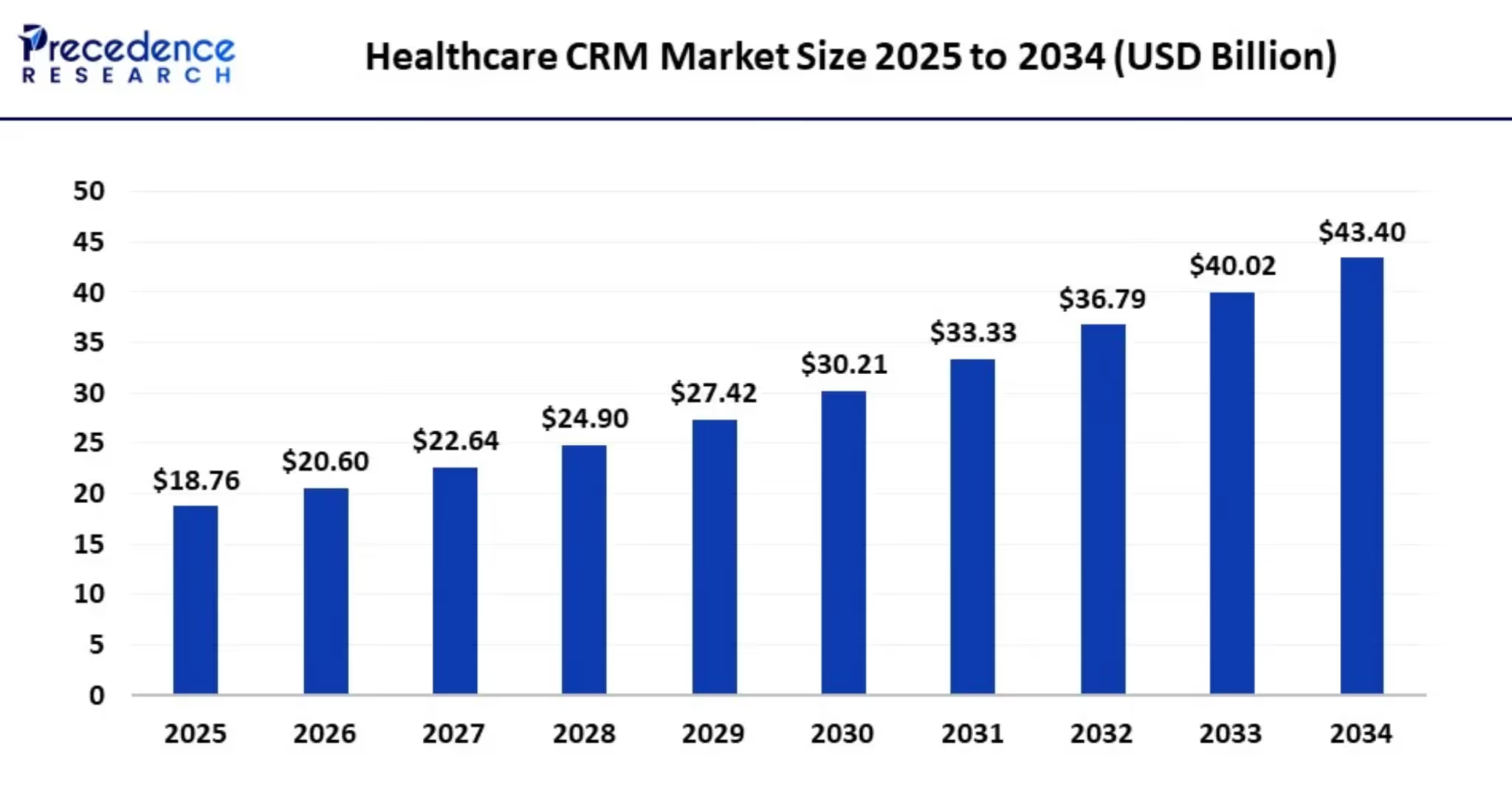
The need for a Customer Relationship Management (CRM) is rapidly increasing in the healthcare sector. According to Precedence Research, the market size of the healthcare CRM is valued at USD 18.76 billion in 2025 and expected to touch USD 43.40 billion by 2034 at a growing CAGR of 9.76%.
Let's explore the use of healthcare CRM software - and why compliance (HIPAA and data privacy) is essential.
What is healthcare CRM?
Unlike traditional business CRMs, healthcare CRMs integrate with Electronic Health Records (EHRs), billing systems, and scheduling tools.
These CRMs provide a 360° view of every patient, therefore facilitating personalized communication, accurate reporting and decisions that are data driven - all while staying compliant with healthcare regulations.
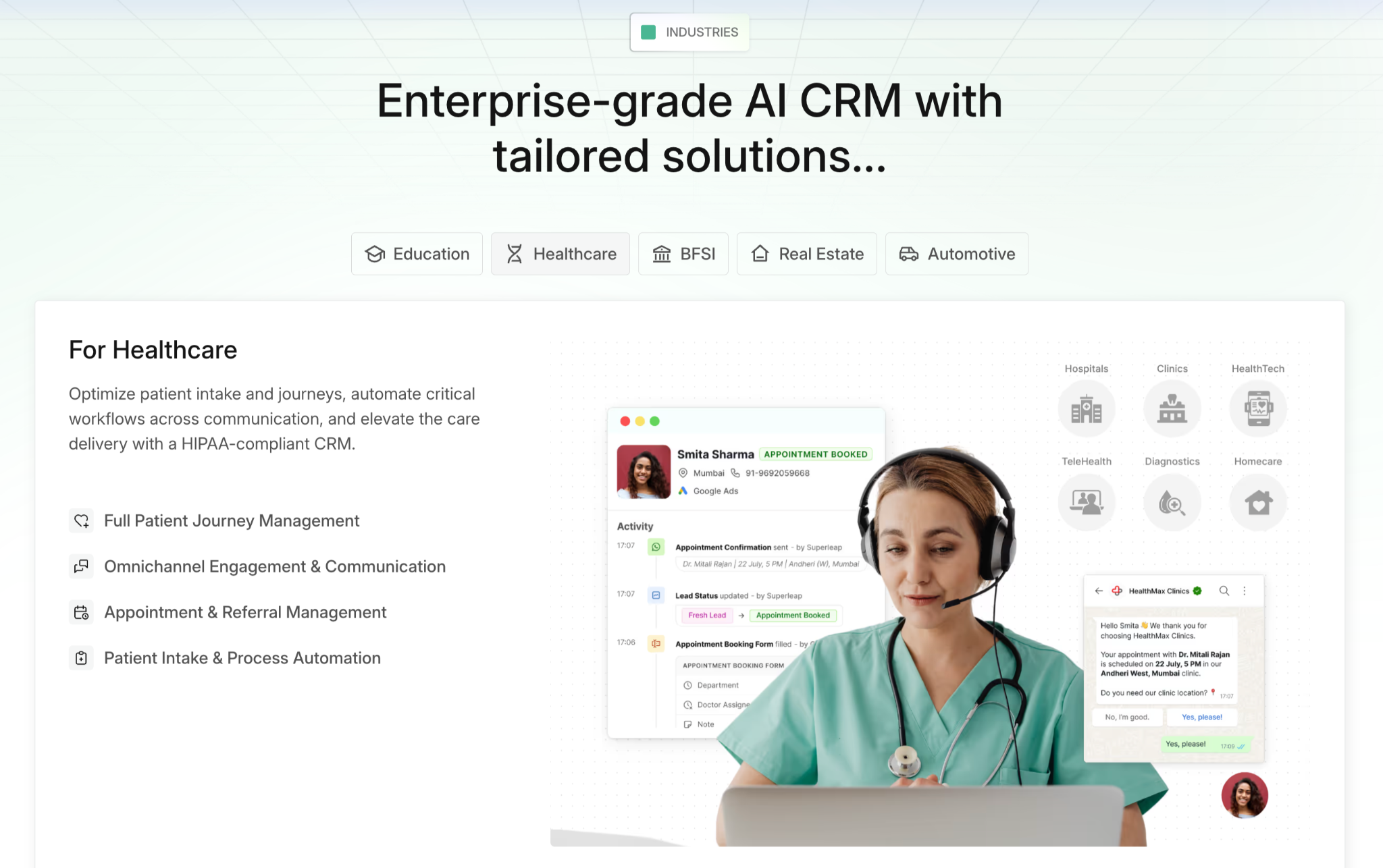
Superleap AI CRM is specifically designed to provide this 360 degree patient intelligence.
What is the use of CRM in the healthcare industry?
A hospital CRM has a broader impact across operations, marketing, and compliance. Here are a few:
Patient relationship management: Stores complete patient history (appointments, treatments, prescriptions) which is used to send follow-ups, vaccinations or even annual check-ups. This personalized communication strengthens the patient-provider bond.
Enhanced patient engagement & communication: A CRM in the hospital industry boosts patient engagement by sending automated reminders about their appointments, payments, test results and medical schedules via SMS/emails, or even WhatsApp messages.
Data management: Instead of scattered files, spreadsheets, and outdated records, a CRM dashboard pulls everything into one platform (demographics, medical history, billing records).
Marketing, outreach & retention: A hospital CRM segregates patients (chronic illness, senior care, maternity, etc.), making it easier to run targeted campaigns to acquire new patients and also retain existing ones.
These insights help plan awareness drives, preventive care programs, seasonal health check-up promotions, optimize referral management workflows, and measure ROI of marketing campaigns.
A CRM like Superleap allows you to automate and offer hyper-personalized engagement across multiple channels.
Operational efficiency: CRMs integrate with billing workflows that guarantee smoother transactions when sending patients payment reminders.
The system also provides complete transparency around insurance claims and outstanding dues, significantly reducing patient confusion and accelerating payment cycles.
Additionally, with healthcare organizations growing rapidly - whether by opening new locations, adding services or even catering to a larger patient base - a cloud-base CRM adapts better to such circumstances without a heavy need for infrastructure change.
Compliance & security: Strict data privacy guidelines are incorporated into healthcare CRMs, frequently incorporating HIPAA compliance in the US or comparable local laws. They provide audit trails to support legal and regulatory requirements while protecting sensitive patient data with encrypted storage and restricted access controls.
In addition to digital safeguards, hospitals must align CRM security with advanced hospital security systems to ensure complete protection of both patient data and physical facilities.
The Johns Hopkins Hospital used its CRM system to create a 100% transparent and secured environment for test results and care coordination data. The platform provided visibility into every step of the patient journey for care coordinators.
Selecting a platform like Superleap guarantees these robust audit trails and access control, necessary for PHI handling.
Key Features of a Hospital CRM Solution
- 360° patient profiles
- EHR/EMR integration
- Appointment scheduling & reminders
- Billing and claims workflow automation
- Marketing automation (SMS/email outreach)
- HIPAA-compliant storage and encryption
- Analytics dashboards for insights
CRM software that’s HIPAA compliant
Privacy of patient data is non-negotiable in the medical field. HIPAA (Health Insurance Portability and Accountability Act) is a standard followed in the US which requires every system handling critical data to secure it against unauthorized access and breach.
Compliance features that HIPAA include:
Access control: Access rights are given based on the role to view PHI (Protected Health Information).
For example, receptionists can view only basic patient details (contact, etc), and doctors can view all the medical history.
Data encryption: All patient records are encrypted. Algorithms like AES (Advanced Encryption Standard, 128+ bit) ensure that even if data is intercepted, it remains unreadable and protected.
Audit trails: Hospital CRMs log all activity, for example, patient record is changed with time stamp and user ID. In case of suspicious activity, an alert will be triggered.
Secure communication: Email and messaging within the CRM is protected for the safety of patient data when exchanged between providers.
Backup & recovery: CRM in hospital industry back up data and have disaster recovery plans to ensure no information is lost.
Hospital CRM Implementation Guidelines
Define the problem statement: What are you aiming to solve? It could be improved operations, better engagement or even tightened compliance.
Pick your top 5 CRM: Select a CRM and other integrations that fit your needs, budget and scalability. Ensure they’re all compliant to healthcare regulations (HIPAA).
Trial run & selection: Pilot test the CRM for efficiency, ease of use and decide on one.
Migrate data & deploy: Move all the patient data to the new system, whilst retaining data quality.
Staff training: Train your staff, evaluate performance and gather feedback to test output.
Investing in a healthcare CRM means investing in patient trust and regulatory safety.
Check out Superleap AI CRM and book a demo today!



.avif)
%201%20(1).svg)
.svg)
.svg)
.svg)
.svg)