
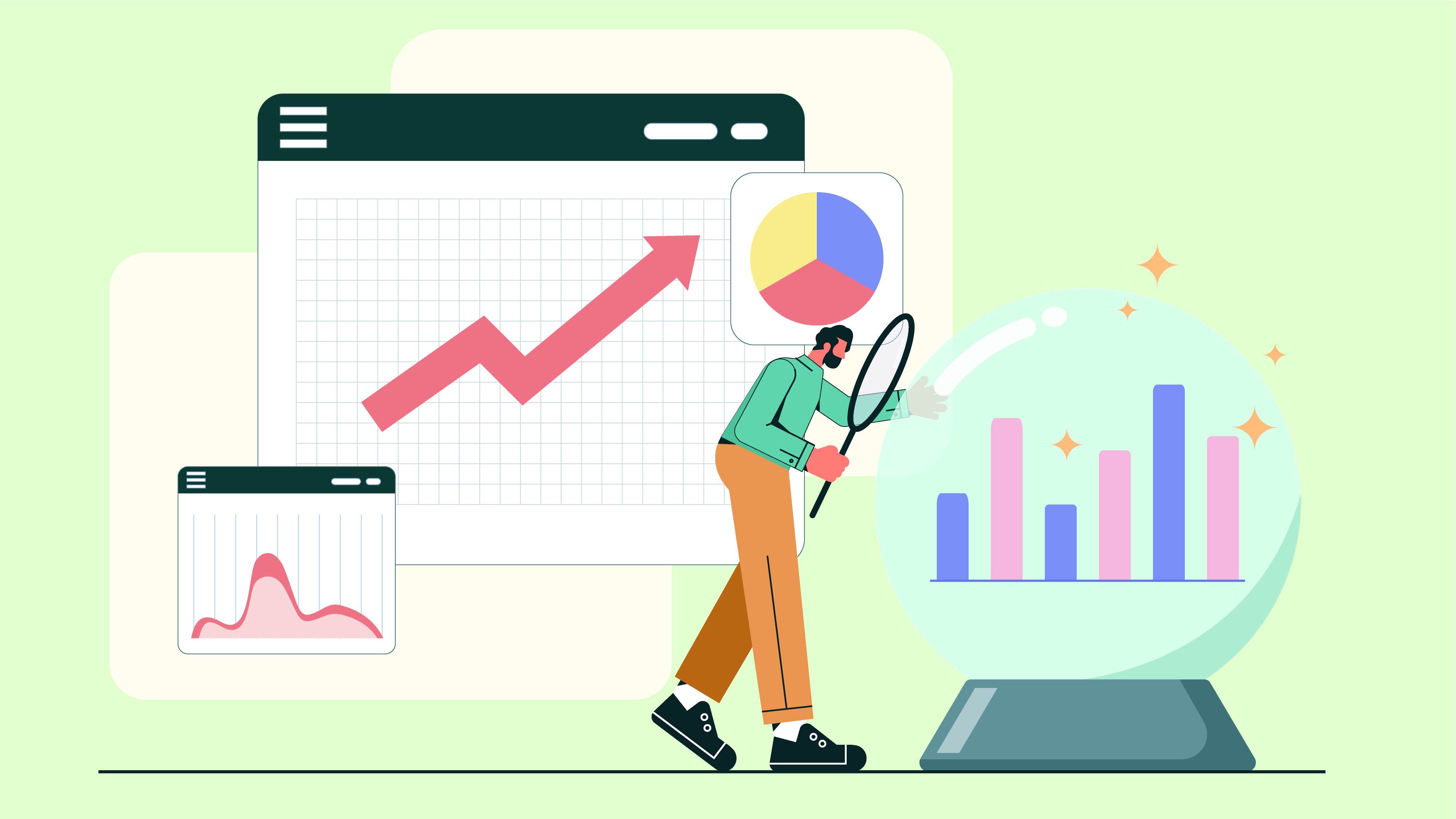


Imagine running a business during a festive sale season and suddenly realizing your best-selling product is completely out of stock. Or worse; ordering way too much inventory for a product nobody wants to buy. Both situations can hurt revenue, waste resources, and frustrate customers. That’s exactly why businesses rely on demand forecasting.
Demand forecasting is all about predicting future customer demand so that businesses can make smarter decisions. By analyzing historical data, market trends, customer behavior, and sales patterns, companies can prepare for what’s coming next whether it’s a seasonal spike, a product launch, or changing customer preferences.
From planning inventory and managing budgets to improving customer satisfaction and optimizing operations, demand forecasting plays a major role in keeping businesses efficient and competitive. And with modern CRM and analytics tools making forecasting more data-driven than ever, businesses can now make faster and more accurate predictions.
In this blog, we’ll break down what demand forecasting is, why it matters, the different approaches and methods used, the forecasting process, common challenges, and the various types of demand forecasting.
What is demand forecasting
Why is demand forecasting necessary?
In India's sales environment, forecasting is rarely a clean data exercise. A pharma distributor in Nagpur runs demand estimates off last Diwali's sales numbers. A Bengaluru SaaS startup uses gut feelings to decide how many enterprise reps to hire for Q2. Both are forecasting; just badly done. Here is why a structured approach changes outcomes across the business.
1. Reduces uncertainty in decision making
Demand forecasting helps businesses anticipate future demand instead of relying on guesswork, enabling more confident and data-driven decisions across sales, operations, and strategy.
2. Improves inventory management
Accurate forecasts ensure optimal stock levels, helping businesses avoid both overstocking and stockouts, while reducing storage costs and product wastage.
3. Supports financial planning and budgeting
By estimating future sales, companies can project revenue, allocate budgets effectively, and plan investments with greater clarity and lower risk.
4. Enhances production and resource planning
Businesses can align production schedules, workforce requirements, and supply chain operations with expected demand, leading to more efficient use of resources.
5. Boosts customer satisfaction
When products are available at the right time and place, businesses can meet customer expectations more consistently, improving trust and loyalty.
6. Enables better use of technology and data
Tools like Superleap CRM help centralize data, track customer behavior, and refine forecasts for greater accuracy.
7. Helps identify market trends and opportunities
Demand forecasting allows businesses to spot emerging trends early, adapt to changing customer preferences, and stay competitive in dynamic markets.
Qualitative vs Quantitative Demand Forecasting: Two Approaches
Qualitative forecasting
Qualitative forecasting relies on human judgment, expertise, and market insights rather than historical data. This approach is particularly useful when there is little to no past data available, such as during new product launches, market expansion, or rapidly changing environments. Businesses gather inputs through methods like customer surveys, expert opinions, sales team feedback, and market research to estimate future demand. While qualitative forecasting can be subjective, it provides valuable direction in situations where data alone cannot capture emerging trends or shifts in customer behavior.
Quantitative forecasting
Quantitative forecasting uses historical data and statistical techniques to predict future demand. This approach is more objective and data-driven, making it ideal for businesses with consistent and reliable sales records. By analyzing patterns, trends, and relationships within past data, companies can generate forecasts using models such as time series analysis or regression. Quantitative forecasting is widely used because it offers measurable and repeatable results, and when combined with modern tools and automation, it can significantly improve forecasting accuracy and efficiency.
Demand forecasting methods
Time series analysis
This is one of the most commonly used demand forecasting methods, as it focuses on analyzing historical data over a specific period of time. This method identifies patterns such as trends, seasonality, and cyclical fluctuations to predict future demand. By understanding how demand has changed in the past, businesses can make informed assumptions about future behavior, making time series analysis particularly useful for stable markets with consistent data.
Moving averages
This is a simple forecasting method that smooths out short-term fluctuations in data to highlight longer-term trends. It works by calculating the average demand over a specific number of past periods and updating it continuously as new data becomes available. This method is easy to use and effective for identifying general trends, but it may not respond quickly to sudden changes in demand.
Exponential smoothing
This improves upon moving averages by giving more weight to recent data while still considering past values. This allows the forecast to respond more quickly to recent changes in demand. It is particularly useful in situations where demand patterns shift over time, as it balances stability with responsiveness, making it a popular choice for short-term forecasting.
Regression analysis
This is a more advanced method that examines the relationship between demand and one or more influencing factors, such as pricing, marketing spend, or economic conditions. By understanding how these variables impact demand, businesses can make more informed predictions. This method is especially useful when demand is affected by multiple external factors rather than just historical patterns.
AL/ML models
Artificial intelligence and machine learning models represent a more advanced approach to demand forecasting. These models analyze large volumes of data, identify complex patterns, and continuously improve their predictions over time. They can incorporate multiple variables, such as customer behavior, market trends, and external events, to generate highly accurate forecasts. While they require more data and technical expertise, AI and ML models are increasingly used by businesses looking to enhance forecasting accuracy and scalability.
Demand forecasting method selector
Demand forecasting process
Define the objective
The first step in demand forecasting is to define your goal clearly. This means understanding what you’re trying to achieve with the forecast whether it’s planning inventory for the next quarter, preparing for a product launch or setting long term revenue targets. Your objective will influence the type of data that you collect, the forecasting method you choose and the time horizon you focus on, making it a crucial point.
Collect relevant data
Once you have decided what your objective is, the next step is to collect relevant data to inform your forecast. This typically includes historical sales data, customer purchasing behavior, seasonal trends, and external market factors. Businesses often rely on tools like Superleap CRM to centralize and organize this information.
Clean and analyze the data
Raw data often contains inconsistencies, errors or missing values which can impact the reliability of your forecast. Businesses clean the data by removing duplicates, correcting inaccuracies, and standardizing formats. Once the data is prepared, it is analyzed to identify patterns such as seasonality, growth trends, or sudden fluctuations in demand.
Choose the right forecasting method
With clean and analyzed data in hand, the next step is to select an appropriate forecasting method. The choice depends on your objective, the type of data available, and the level of accuracy required. For instance, time series methods are useful for identifying historical patterns, while regression models help understand relationships between variables. In situations where data is limited, qualitative approaches like expert judgment may be used. Many businesses combine multiple methods to improve forecast reliability.
Generate the forecast
After selecting a method, businesses use it to generate the demand forecast. This involves estimating future demand over a specific time period, such as weekly, monthly, or annually. Modern CRM and analytics tools can automate this process, making it faster and more accurate. At this stage, the forecast becomes a practical output that teams can use for planning and decision-making.
Validate the forecast
Before relying on the forecast, it is important to validate its accuracy. This is typically done by comparing predicted results with actual historical outcomes to assess how well the model performs. Validation helps identify gaps, biases, or errors in the forecasting approach, allowing businesses to make necessary adjustments before implementation.
Implement and monitor
Once validated, the forecast is put into action across relevant business functions. This may involve adjusting inventory levels, aligning production schedules, or setting sales targets. However, forecasting is not a one-time activity. Businesses must continuously monitor actual demand and compare it with forecasted values to ensure they remain aligned with real-world conditions.
Refine and improve
The final step in the process is ongoing refinement. Market conditions, customer preferences, and external factors can change over time, which means forecasts must be regularly updated. By incorporating new data, revisiting assumptions, and improving models, businesses can enhance forecast accuracy and make more informed decisions in the future.
Types of demand forecasting
Short-term vs Long-term
Macro-level vs Micro-level
Active vs Passive
Internal vs External
Common demand forecasting challenges (and how to solve them)
Inaccurate or incomplete data
One of the common challenges in demand forecasting is poor quality data which leads to unreliable predictions and flawed decision making. This often happens because data is spread across multiple systems or is not maintained accurately. In order to solve this, businesses should consider using a CRM like Superleap to centralize the data and maintain consistency across the systems.
Unexpected market changes
Demand gets influenced by unexpected events such as economic shifts or competitor actions. These changes make it difficult for forecasts based on historical data to remain accurate. Businesses can tackle this by using flexible forecasting models and updating forecasts regularly based on real-time data.
Lack of cross functional alignment
Demand forecasting often involves multiple teams like sales, marketing, finance, and operations. In Indian mid-size companies, it's common for the sales team to maintain a WhatsApp group with demand updates while the finance team works off a Q1 Excel file that's already three months old. These silos produce contradictory forecasts and missed targets. Fix: establish a shared CRM-based dashboard where all teams access the same data in real time. Run a monthly S&OP (Sales & Operations Planning) meeting, even a 30-minute call, to align the forecast before it's actioned.
Picking the wrong forecasting method
Choosing the wrong forecasting methods can impact accuracy. For example, using a simple model for complex demand patterns or a complex model with insufficient data can lead to poor results. Businesses should evaluate their data, objectives and resources before choosing a method and consider combining multiple techniques to ensure reliability.
Difficulty in handling trends
Many businesses experience seasonal demand fluctuations or long term trends that are not always easy to identify or model. Ignoring these patterns can lead to overstocking or stockouts. Businesses should use forecasting methods which account for seasonality and consistently analyze data to detect emerging trends.
Conclusion
Demand forecasting is not a luxury reserved for large corporations with data science teams. An MSME distributor in Surat running five SKUs can implement a three-month moving average in Excel in one morning. A pharma sales manager in Mumbai can use regression to map hospital tender cycles before competitors know the pattern. The level of sophistication you need depends on your business size, data quality, and what decisions you're actually trying to make better. Start with the simplest method that solves your most expensive mistake, usually a stockout or a wasted quota target and build from there.
While no forecast can be perfectly accurate, the real value lies in building a structured, data-driven approach and continuously improving it over time. By combining the right data, tools, and techniques and addressing common challenges along the way; businesses can reduce uncertainty and make more confident decisions.
Ultimately, demand forecasting is not just about predicting the future; it’s about preparing for it.





%201%20(1).svg)
.svg)
.svg)
.svg)
.svg)